
The Autonomous Freight Desk
The Challenge
For a high-volume 3PL freight broker, growth is usually handcuffed by headcount. Our client was stuck in a manual "grind": brokers spent 70% of their day managing thousands of emails, chasing carriers for quotes, and manually checking market rates to ensure they didn't underbid.
The volatility of the spot market meant that by the time a broker manually calculated a price and emailed a shipper back, the market had shifted or a competitor had already snagged the load. They needed a way to scale their volume without doubling their staff or sacrificing their margins to "guesswork" pricing.
Our Solution
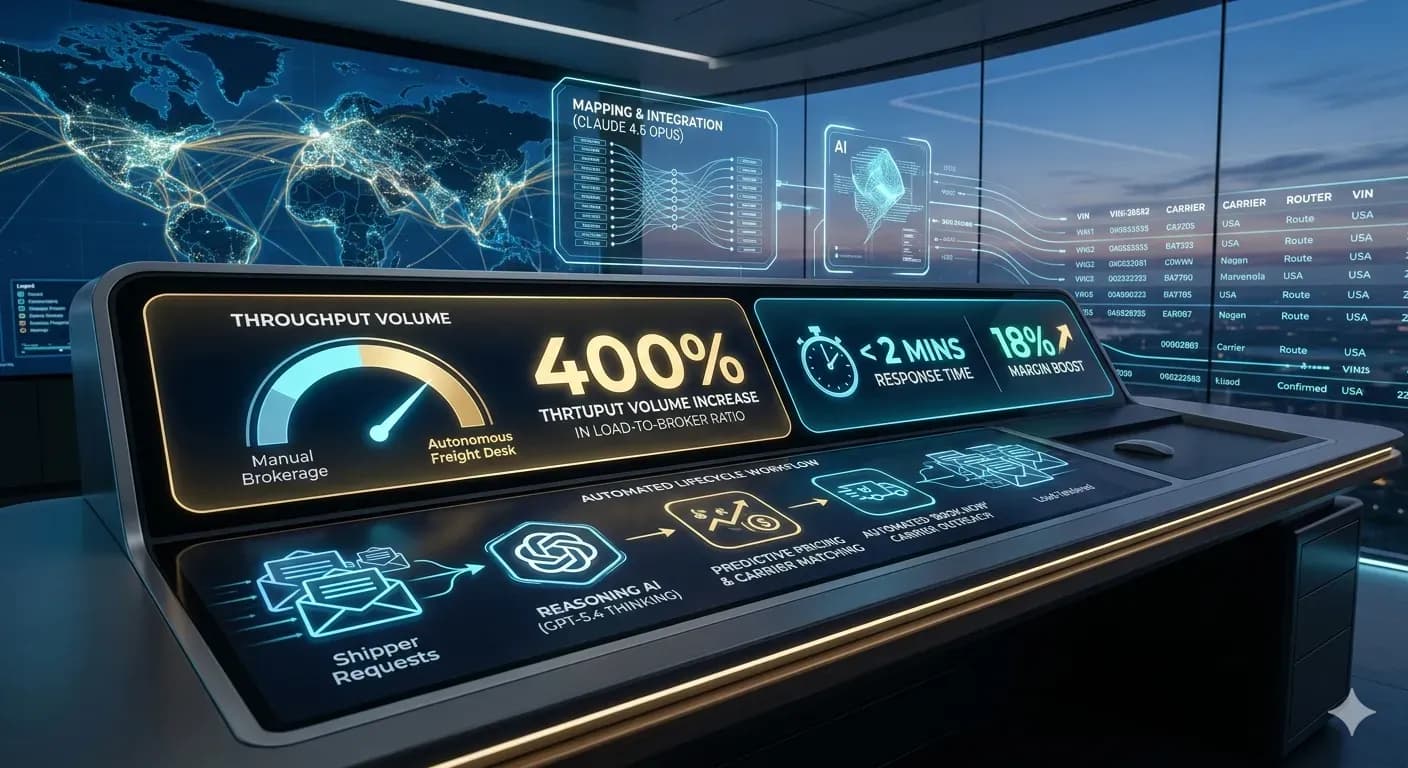
We architected an Autonomous Brokerage Engine powered by the latest GPT-5.4 Thinking models. This wasn't just a simple parser; the system now has deep reasoning capabilities to understand nuanced constraints in shipper emails (like specific tarping needs or complex "blind shipment" instructions) that older models often missed.
We used Claude 4.6 Opus to build and maintain the complex data-mapping layer between heterogeneous carrier systems. This is paired with a Predictive Pricing Engine that runs real-time simulations to generate an "optimal bid" instantly. The Automated Carrier Matcher then identifies the top five most reliable carriers and initiates "book now" workflows via SMS and email, moving from "request" to "tendered" without a human touching a keyboard.
The Results
The transition moved the company from "reactive" to "proactive." By automating the repetitive intake and matching process, individual brokers were able to manage 4x more loads than before, focusing only on high-value negotiations and complex exceptions.
The speed of the AI-driven quoting led to a significant win-rate increase, as the client became the first to respond to nearly every bid. Most importantly, the predictive pricing reduced "margin leak", instances where they overpaid for a carrier or undercharged a shipper, resulting in an 18% boost in overall profitability across their most volatile lanes.


